
Shaping Our Communities: Art Students Forge Historical Tribute for Ninety Six
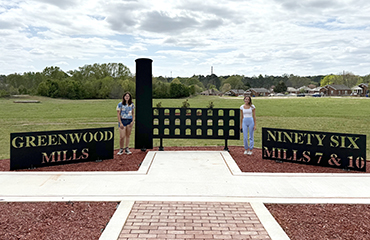
Lander BFA students, from left, Cathryn Burger and Elena Medlin crafted two large name plates and a silhouette for the Ninety Six Mill Park. Photo by Doug McAbee
The site of two historic mills in Ninety Six has been transformed into a special place to remember South Carolina’s textile heritage, and three students from Lander University’s Department of Art played a major role in the park’s development.
Last spring, the Ninety Six Mill Village Neighborhood Association commissioned Lander BFA student MG Morrow to craft a pair of custom steel sculptures for a new neighborhood park. Morrow’s project, part of ART 432, Advanced Sculpture Studio II, was to create custom silhouettes of two millworkers – one man and one woman. The silhouettes were installed in conjunction with a turnstile salvaged from the original mill site, to appear as if the two workers are passing through.
As the purpose of the park was both to pay homage to the past and honor the future, it was important for the association to include local students. In addition to Morrow’s work, the association also hosted an art competition for students in Ninety Six schools. The park was dedicated this past fall in celebration of the mill village’s 100th anniversary and pays tribute to the mill workers of Greenwood and Ninety Six, wherever they may have worked.
Meanwhile this past semester, two Lander BFA students returned to the park for a second phase. Cathryn Burger and Elena Medlin worked together to create two large name plates that read “Ninety Six Mills 7 & 10” (the two mills that formerly stood on the land used for the park) and “Greenwood Mills.” These name plates flank the students’ beautiful centerpiece – an easily recognizable silhouette of a textile mill with its iconic smokestack and large arched windows.
“I’m really proud of these students,” said Professor Doug McAbee, of Lander’s Department of Art, who advised the students through both projects. “Not only of their work, but of their professionalism and development as artists.”
Measure Twice, Cut Once
Most people will remember iconic Bob Ross’ famous line, “We don’t make mistakes, just happy little accidents.” And while it is true that a wrong brush stroke or an accidental splatter on a painter’s canvas can often be reworked after the fact, working with steel presents challenges that are harder for sculptors to correct in retrospect, and thus requires more logistical planning before an artist makes their first cut.
For McAbee, though, this is a good thing for students to experience – the physical limitations of the real world, which inspire students to think creatively within those parameters.
“I think that honestly, it furthers the creativity,” McAbee said, “because you have to do the critical thinking, and you have to do the creative problem-solving. You can sort of move things around, and you can change things on a flat canvas that don’t really have to be physically possible. But when you’re working with something like this, there are physics involved.”
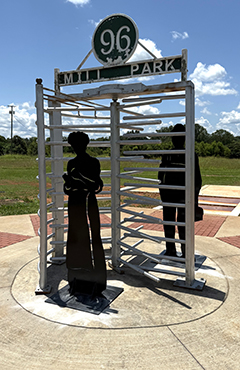
Pictured are two silhouettes honoring millworkers, crafted by Lander BFA student MG Morrow. Photo by Doug McAbee
Real-World Skills
Projects like these, according to McAbee, are not only consistent with Lander’s objective to use experiential learning opportunities to prepare students for their futures, but they’re also in line with McAbee’s own personal objectives as an art educator.
“I want my students to be great,” McAbee said, confidently. “So, I’m going to teach them all the technical skills that I can teach them. I’m also going to make sure they’re real-world skills so that they can do exactly what they want to do when they graduate.”
These two projects for the Ninety Six Mill Village Neighborhood Association are examples of those real-world skills. Students saw what it was like to work as public artists. They worked directly with a client, crafted a proposal, sought feedback along the way and even worked with McAbee to draft up a contract.
Once the projects were finished, the students were also involved with the installation of their work at the park.
“The students went out to the site, and the neighborhood association was there,” McAbee recalled. “They were able to talk about themselves and their artwork with the customer and put a real face to the art that was being created there.”
Ready for the Future
Whatever life after Lander looks like, these experiences that take learning out of the classroom or studio space have a long-lasting impact for Lander students. Some have gone on to practice as artists full-time – in fact, Lander’s Department of Art has produced a score of successful alumni who are working in the arts, or in art education.
However, not everyone who earns an art degree chooses to pursue a career in the arts. McAbee says that’s not a concern, since he knows those same students have a powerful education that enables them to thrive in whatever profession they decide to enter. He’s confident that his students will always be able to find meaningful ways to contribute their creativity to their organizations and their communities.
“My concern is that they can do whatever artistic endeavors they want to do, personally or professionally, when they graduate,” McAbee said. And, in Lander’s Department of Art, alumni leave ready to pursue those endeavors and make the world a more beautiful place.