
Lander Lecture Examines the History of Cocktails and the American Story
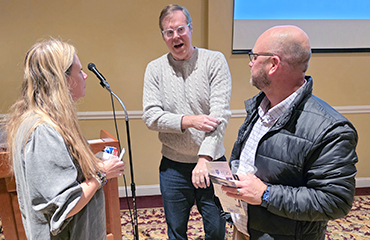
From colonial taverns to modern mixology, Dr. Andrew Jameson has traced America’s spirited past -- one cocktail at a time.
Jameson, an associate professor of English, presented his findings during Lander’s second Community Lecture Series program of the Fall 2025 semester, which explored how drinks and drinking culture have reflected the nation’s evolving social, political and economic identity.
His interest in how cocktails and spirits shaped American history grew from receiving a gift of the book, Vintage Spirits and Forgotten Cocktails, written by Ted Haigh. Jameson described the gift as “one of the best presents I never knew that I wanted.”
In the years that followed, Jameson has meticulously and perhaps enthusiastically studied the drinks that have defined America from the colonial era to modern history and began his own pursuit of recipes and the stories behind them. His talk, which offered a fresh and flavorful perspective on alcohol in America, included tales of rebellions, speakeasies, tropical influences and the impact of martinis on American business.
America’s History and Alcohol
“This country has loved to drink,” Jameson said, noting that America’s alcohol story begins with the sugar cane and molasses produced from the islands of the West Indies.
With the production of rum in the 17th century, “sugar cane was king in these areas,” he said, noting that molasses – a key ingredient for making rum – produced economic trade benefits for the American colonies, England and Europe.
In the early 18th century, America began distilling its own rum, and the Sugar Act, ultimately imposed by England, antagonized the colonists whose fury was levied against the taxes they were forced to pay.
The American Revolution brought about the decline in the rum industry and fostered the production of whiskey, produced from local corn.
As settlers moved from the Northeast to southern areas, such as Appalachia, they discovered that Kentucky had the perfect water and climate for making bourbon, an American whiskey. “It was the drink of the masses,” said Jameson, noting that the consumption of whiskey grew so great that America became the “drunkest nation on the planet.”
History Shaped by “Spirits”
Among the other highlights of Jameson’s talk on the history of drinking in America:
- George Washington was one of the first major distillers of whiskey. In 1799, his business produced 11,000 gallons of whiskey.
- As ice became available in the 1800s, drinks became fancier and more refined. After all, what would a mint julep be without frosty crushed ice, Jameson said, stating that politician Henry Clay brought the mint julep to Congress.
- Bitters, which had been a staple of the patent-medicine industry in the 1800s, began being added in small amounts to drinks, including the Sazerac, a classic cocktail in New Orleans, featuring Peychaud’s bitters.
- The Golden Age of American cocktails and the popularity of mixologists occurred between the mid-19th century and the start of Prohibition in 1920. The era was marked by bartending as a profession, including the rise of Jerry Thomas, who created the Blue Blazer, a flaming cocktail. Thomas’ 1862 book, How to Mix Drinks or the Bon Vivant’s Companion, included the Blue Blazer, which remains a classic.
- The Prohibition era “made for some strange bedfellows,” Jameson said, observing that the 18th constitutional amendment passed in 1919 to outlaw alcohol in the United States “didn’t stop people from getting alcohol.”
- The cocktail, Scofflaw, emerged from the Prohibition era and featured whiskey, vermouth, lemon juice, grenadine and bitters.
After the repeal of the 18th amendment in 1933, America’s drinking history incorporated widespread influences, including World War II; an explosion of business and industry nationwide which saw the invention of the martini; an increase in travel; and the growth of the tiki culture, made famous by Ernest Raymond Beaumont, also known as Donn the Beachcomber.
History Lives Beyond Textbooks
Jameson’s talk is a reminder that history isn’t confined to textbooks. “It’s always good for faculty to share their interests and their expertise with the community,” said Dr. Lucas McMillan, dean of Lander’s College of Humanities, Arts and Social Sciences.
“This lecture series at the Arts Center in Uptown Greenwood lets our faculty show themselves as great teachers, as great enthusiasts for different areas of knowledge,” he said. “Dr. Jameson is a person who teaches writing and teaches storytelling, and it was great to hear the stories behind many of the cocktails and the drinks that have shaped American history."