
For Franklin Rausch, History Is All Fun and Games
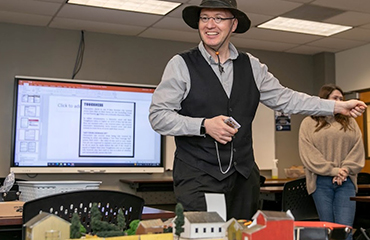
Think history’s boring? Not at Lander University, thanks to a professor who brings history to life through games designed to mix facts with fun while learning.
About five years ago, Dr. Franklin Rausch, a Lander history professor, decided he wanted to teach beyond lecturing. He drew on his past experiences of playing many different games in his youth to develop games for the classroom. As he worked on the intricacies of design, he turned to the University’s print shop to print cards and boards to bring history to life.
“Students reacted positively and gave me good feedback on how to improve the games,” he said.
Now a President’s Grant, made possible through a program initiated by Lander President Richard Cosentino, will enable Rausch to enhance the gaming experience for students and other faculty.
Expanding the Teaching of History
“This grant will be used to purchase equipment for the Experiencing History Lab so that we can make instructional videos for the games I’ve been developing, as well as to hire students to help with the development of those videos,” Rausch said.
Each game developed in the Experiencing History Lab will typically be accompanied by a series of videos: one to introduce the game and explain the rules, one of students playing the game, and one that instructors can play in their classrooms to support student learning.
“The files will also be made available so instructors can get copies of the games. All of this will be posted on Lander’s website,” he said.
Laughter in the Classroom
The games help students to stay engaged, Rausch said.
“They laugh and tease each other over how the game goes, helping them to stay focused,” he said. “If you throw in some competition and luck -- like throwing dice or drawing cards -- it helps people pay attention. It also helps them discover things for themselves and see how historical principles work out,” he said.
For example, in a traditional lecture, Rausch could explain that increasing efficiency in food production allowed specialization so that human beings could develop new technologies. This, in turn, allowed even greater food production.
“Or I could have students play a game where they guide a group of early humans and see how the pots that they figured out how to make prevented rats from eating their grain or how the stone walls protected their livestock from wolves, allowing their village to grow,” he said.
“Likewise, I can tell students that the Black Death created a lot of fear in Europe and destabilized society, or they can play as a family trying to survive the Black Death and have to figure out what to do when a loved one comes down with the illness.”
Games Have No Limit
Rausch has used his history games to teach introductory classes and upper-level classes for history majors. The games have been used for European history courses, as well as classes on America’s “Wild West” and the skirmishes and battles of the American Revolution, including the two Revolutionary War battles in Ninety Six.
“A game can be tailored to fit anywhere,” he said.