
Disagreeing, But Remaining Friends: Constitution Day Highlights Civil Discourse for Lander Students
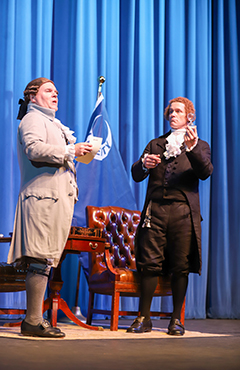
The political discourse among the Founding Fathers was complex and often contentious. Although they shared a common goal of establishing a free and independent nation, the leaders held profoundly different visions for how that nation should be governed.
Their dissension, vigorous and politically charged in the 18th century, was given a 21st-century interpretation during Lander University’s Constitution Day observance. Sponsored by Lander’s Jackson Lecture Series, the event featured historical actors Steven Edenbo, portraying Thomas Jefferson, and Peyton Dixon, portraying John Adams, for “A Visit with John Adams and Thomas Jefferson: We Disagree as Rational Friends.”
The banter and interactions in the performance – sometimes terse, sometimes humorous – highlighted the conflicting visions of power and liberty held by the Founding Fathers who first drafted the Declaration of Independence and then gathered at the Constitutional Convention in 1787 to write the document that established the structure and operation of the federal government.
Jefferson and Adams: Differing Views, Reconciliation
Jefferson and Adams themselves are a study in the struggles of the nation’s birth and growth. “They were both passionate revolutionaries and worked together, especially in the beginning, to move the colonies toward independence,” said Dr. Ryan Floyd, chair of Lander’s Department of History and Philosophy.
“However, they had differing views on what that new nation should look like and how it should be governed. Jefferson preferred a weaker central government, where more rights remained with the states and the people. Adams felt that a strong central government was necessary,” he said.
Although Jefferson was serving in France and Adams was in Great Britain during the Constitutional Convention, “they were paying as close attention to the debates as they could,” Floyd said. “Like a lot of the delegates at the convention they saw the challenge being, how do you create a government strong enough to manage the affairs of a large nation, but one that would not threaten the liberties of individual Americans.”
During his portrayal of Jefferson, Edenbo said, of Alexander Hamilton, who helped draft the Constitution, “we learned to respect each other grudgingly.”
Discord and grudges were not uncommon among the nation’s first leaders. As time passed, the political differences deepened between Adams and Jefferson when they became political adversaries to become president of the United States. Adams won in 1796, with Jefferson defeating him in 1800. They did not speak again until 1811.
“What I like about their story is that despite their political differences, they were able to forgive each other and rekindle that friendship,” Floyd said. “It is a wonderful example of how people with differing viewpoints could still find common ground and be civil with each other.
A Relevant Message in the 21st Century
During the performance, the actors portraying Jefferson and Adams explained that there have always been arguments and discussions in our democracy about the meanings of freedom, liberty, equality and responsibility, said Dr. Lucas McMillan, dean of the College Humanities, Arts and Social Sciences.
“In a time of political polarization, we wanted our students to see examples of civil discourse, a tradition that goes back to the debates about the words and ideas expressed in the Declaration of Independence and the U.S. Constitution,” he said.
Lander University’s vision is for students to be “broadly educated, well-informed and equipped for responsible participation in the civic lives of their communities,” McMillan said. “For this reason, we are committed to teaching about the founding documents of our nation.”
The U.S. government requires institutions that receive federal funding to provide instruction on the Constitution, and the South Carolina REACH Act (Reinforcing College Education on America’s Constitutional Heritage) requires public universities to teach about the founding documents to all students, he said.
“For all of these reasons, we are happy to not only teach about these documents, but also to create special programming for our students and community members.”