
Lander’s Finnerty Takes Education to California for Exciting Research Opportunity
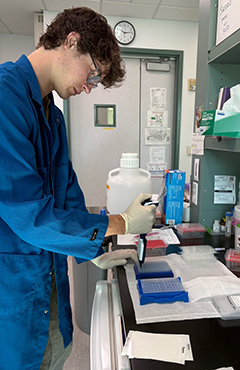
When it comes to providing students with exciting summer learning experiences, Lander University is number one. That is, except for senior environmental science major Keegan Finnerty - his summer internship at UC Davis was number two...
Finnerty spent the summer in the field and in the lab with the Mammalian Ecology and Conservation Unit at UC Davis using DNA metabarcoding on fecal samples to characterize the diet of an endangered species of fox in California.
“Throughout the summer I've been primarily dealing with samples from an urban population, but after I return to Lander, I'm going to continue working for the lab remotely to see how the diets of the urban vs natural populations compare,” Finnerty said. He and his mentor will hopefully publish their research in a paper.
During the internship, Finnerty developed strong lab, data analysis and communication skills, he said. He spent time in the field collecting scats; in the lab extracting, tagging and amplifying target DNA; and in the office doing data analysis and computer programming. He also presented a poster during the internship. The experience solidified his desire to pursue graduate school and a career in research.
“Through my own project and the projects of others within the lab, I was able to gain a lot of knowledge on the use of genetic tools for wildlife conservation, an area I knew very little about going into this experience,” Finnerty said.
“Most importantly though, I was able to really gain an understanding of what it is like to work in a research lab. In just seven weeks I was able to get trained on various lab techniques, attend weekly lab meetings, learn new concepts from my mentor and other grad students in the lab, help with sample collection in the field, learn new data analysis methods, create a poster and present my research.”
Finnerty said his education at Lander helped make the most out of the internship. He has already presented research at a conference with Lander, so was confident in his ability to communicate and talk about scientific research.
“I also took the Environmental Data Science course before this, which provided me with a background in the R programming language,” he said.
“I feel that this background knowledge provided me with a head start and allowed me to complete much more work than I would've been able to if I had gone into this without that knowledge.”