
Lander Students Recreate Virtual Campus in Minecraft
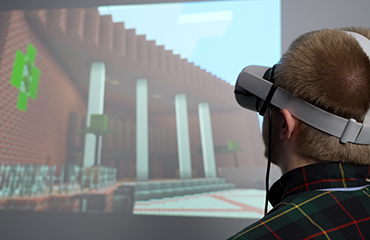
In another reality, Lander University can be visited by people from all over the world without leaving their homes. Almost every building was crafted by Lander students.
Students in Dr. Walter Iriarte’s video game theory class spent the last month of the semester putting their knowledge into practice and recreating Lander’s campus block by block in the pixelated world of Minecraft.
Click here to access the Lander University Minecraft: https://open.minecraft.net/pocket/realms/invite/DW3Dk3dKEA3Aqfs
Minecraft is one of the best-selling video games in the world and from wherever they are in the world, its players will be able to explore Lander’s campus, meticulously crafted by students down to the landscaping, people in the dining hall and iconic fountain.
The video game theory course began as a proposal from Iriarte after Lander President Richard Cosentino held a meeting about virtual reality.
“Video games have played an important role in computer technology,” Iriarte said.
In the course, students learned about the theories that have been applied to video games and explored games to see those theories in action. The class even took a trip to a local arcade.
The students applied the theories when building Lander’s campus in Minecraft, hiding Easter eggs – a surprise feature in games or movies – and creating mini-games visitors can play.
“One thing is for sure, when it comes to understanding concepts, especially in my course, it was a great way for them to apply these theories and make them more tangible, make them a lot more understandable,” Iriarte said. “Project-based learning is a huge factor when it comes to teaching anything. Nowhere is it more relevant than in Minecraft.”
“I’ve noticed in my students that they’ve been able to articulate these heavy theories that usually you learn in graduate school and I’m bringing it down to a level that’s a lot more comprehensible,” he added.
Sage Cameron was one of the students who took the inaugural course and took it because video games are one of his biggest passions in life, besides film.
“The fact that the course was opening up to students, I was excited and wanted to be one of the ones to try it out first,” he said.
Popularity, Compatibility, Affordability
There are multiple reasons Iriarte chose Minecraft for his course. Popularity, for one, because even before the recent release of a feature film based on the game, it was one of the best-selling games in the world. Iriarte pointed out video games don’t often have a long life-span before they begin to lose relevancy and only a few mega-popular games see long-term success. Minecraft, first released almost 15 years ago, has seen that long-term success.
Another reason is the compatibility of Minecraft. It’s a cross-platform game, so players can enjoy it from their smart phone, computer or from numerous gaming consoles. It’s also beginner friendly.
“No matter what your social status is, no matter if you classify yourself as a pro-gamer or a newbie, it doesn’t matter,” Iriarte said. “Minecraft is relatively easy to figure out. And even once you do, there’s so many Easter eggs you can find.”
Minecraft is also relatively affordable when compared to many other popular video games. From about $7 on a smart phone to around $30 on console, Iriarte said most parents are willing to pay for a game that encourages creativity.
Build It
Each student in Iriarte’s class was assigned a building on Lander’s campus to build in Minecraft. They also had to demonstrate one of the theories they had studied during the semester as part of their build.
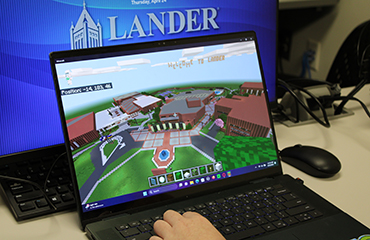
“It’s a great way for people to realize that compared to high school or college, there’s a lot of different ways to learn or express yourself,” said student Brooks Grayson. “So not only did we create Lander on Minecraft, but in it, we applied theories, so we’re able to take what we’re learning and apply it practically. It’s a great way for people to see there’s a lot of different ways to learn in college.”
Student CJ Stuart said the theories studied in the class can be applied to broader contexts than just video games – they inform how you look at other pieces of media and real life.
All of the students in the course had some level of experience in the game before.
“I was very excited to start building Lander in Minecraft because the first thing I always did in Minecraft was rebuild stuff,” said Kimberly Duclos. “I rebuilt my house in Minecraft, I rebuilt my whole neighborhood, so this isn’t the first time I’ve done something like this… I was very excited to do it again after so many years.”
Duclos was responsible for building Jackson Library in the Minecraft world and worked on landscaping around campus.
Haylee Gower, who built the Minecraft world’s PEES building, said she actually went and walked around the building and took photos to get an understanding of the inside. One challenge she faced was replicating equipment using only Minecraft’s square blocks.
Grayson, who had less crafting experience than some of her classmates, spent a lot of time doing unexpected research on Minecraft.
…And They Will Play
The video game theory course offers a fresh way to teach students about media and the rhetorical and philosophical applications used in its production. A second benefit is that the world the students have created will allow anyone to visit Lander’s campus in the virtual world.
“I think the Minecraft world is going to impact Lander in some pretty big ways,” said Cameron.
The world can be used to get some younger people in the door, he said, especially younger people who may be open to exploring colleges but not yet to the point of booking in-person tours.
“It’s a good tool for Lander to connect to the younger generation,” said Gower.
“More and more people are playing video games, regardless of if they’re a boy or girl or a young person or old person, so I think it’s something really vital for us to connect to and start using for us to get as big of an audience as we can at Lander because Lander is a really good school and I think more people should go.”
Lander’s campus is changing – a handful of buildings are going to be under construction in the next few years and they will be built in the Minecraft world once finished, Iriarte said.
“I’m really looking forward to seeing how this project grows,” he said.